How to choose the right industrial weighing system for your operations
20 October 2026
Choosing an industrial weighing system is not simply a matter of selecting a load cell, an indicator, or an axle weigher from a catalogue or website. A successful project begins with a rigorous analysis of operational requirements, site mechanical constraints, metrological standards, and the final use of the collected data.
This 7-step method allows you to design a reliable, durable weighing architecture that seamlessly integrates into your processes. Sitting at the very core of our industrial weighing expertise, it is designed for technical managers, maintenance managers, process engineers, automation engineers, quality managers, and project leaders looking to structure their specification document before consulting a manufacturer or integrator.
Why is there no universal industrial weighing system?
In the field of industrial weighing, every installation addresses a unique combination of mechanical, environmental, and IT constraints. A solution that is perfect for a packing station may prove to be unstable or impossible to maintain on a dosing line or a storage silo.
The primary question is not:
“Which equipment should we buy?”
It should be:
“What strategic or operational decision must the company make based on this weight reading?”
One Single weight, different operational goals
A gross weight value serves vastly different objectives depending on the department using it:
Production & automation: Controlling material dosing, regulating flow rates, or stopping a filling cycle.
Maintenance & engineering: Monitoring storage levels, detecting overloads, or analysing load distribution on a chassis.
Quality & logistics: Verifying a formulation, confirming finished product compliance, tracking a batch, or issuing a shipping note.
While mass data physically remains the same, the hardware architecture, acquisition speed, and required accuracy level vary dramatically depending on the application.
Functional requirements drive architecture
Weighing data must be available at the right time, in the right format, and in the right place. Depending on your organization, the measured value will either remain local or directly feed your IT systems.
Maximum capacity and display resolution alone are therefore never enough to define a project. The number of users, cycle frequency, environmental severity (washdowns, vibrations, ATEX hazardous areas), and process criticality directly shape the overall architecture.
The common design error :
Framing a request as “We are looking for a load cell” or “We need an axle weigher” amounts to imposing a hardware solution before even characterizing the issue. An effective engineering approach first defines the core function and the associated operational risks.
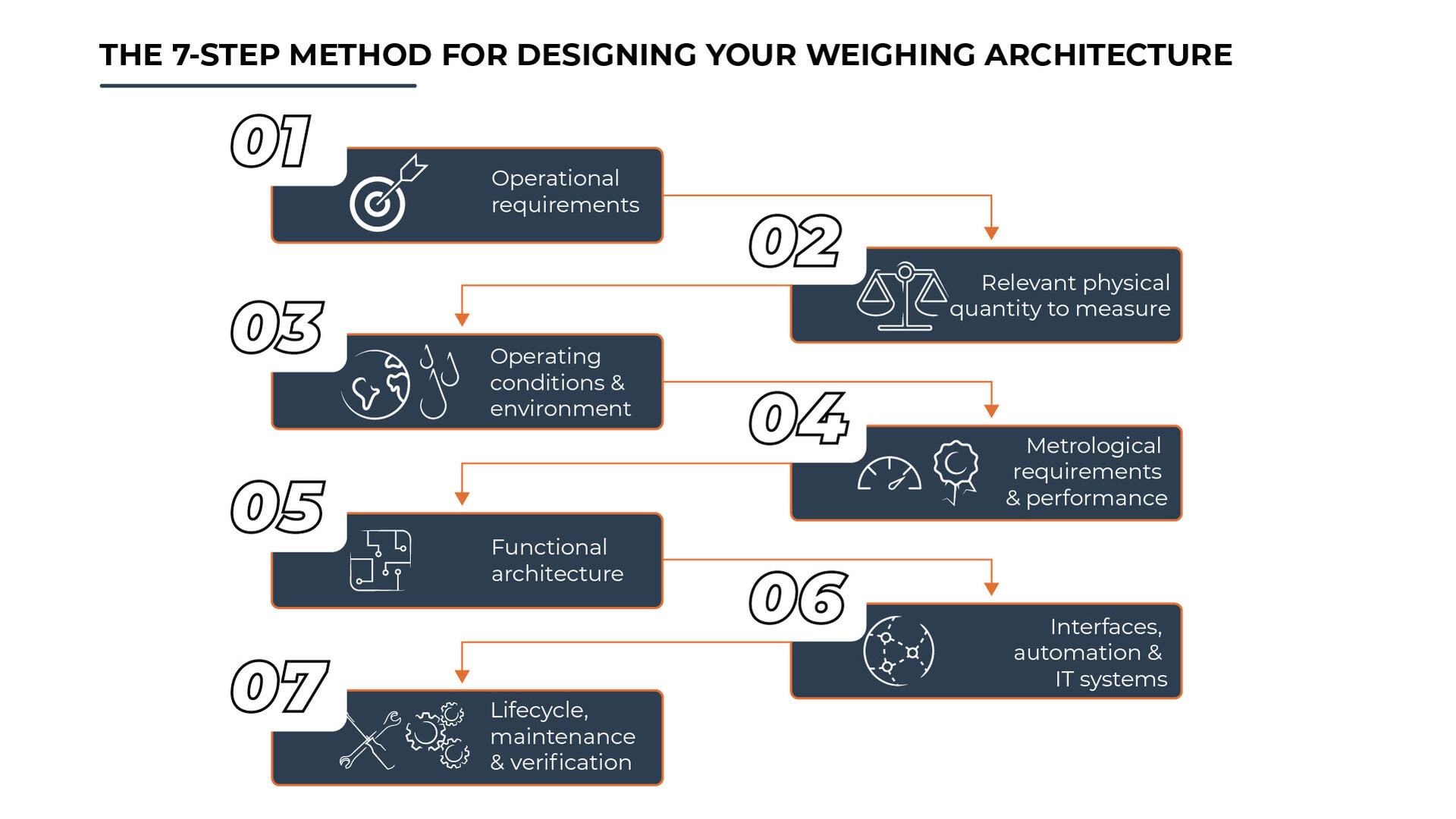
The 7-step method for designing your weighing architecture
Selecting a system relies on seven consecutive decisions. Hardware (load cells, weight sensors, acquisition cards, indicators) only comes into play at the very end of the process.
Step 1: Define operational requirements and the regulatory framework
The first step specifies the operational purpose and identifies the end users of the data. This stage is also where a fundamental question must be settled: Internal Process Weighing vs Legal Metrology.
Process weighing (internal use): Intended for production tracking, inventory control, or automated process control. The installation prioritizes repeatability, acquisition speed, and robustness.
Commercial transactions (Legal Metrology – Approved use): Whenever weight forms the basis of a financial transaction, tax calculation, or regulatory check, the equipment must be legally approved for trade (inspection sticker, metrology logbook, physical seals, and periodic verification).
Key engineering questions:
What precise problem must the weighing system solve?
Does the measurement simply inform the operator, or does it control an automated system in real time?
Is the system subject to legal metrology (trade approval)?
What are the financial, regulatory, or safety consequences of a measurement error?
Field tip: Draft your requirements without specifying equipment. Prefer phrasing such as: “Monitor total mass and left/right weight distribution of a road-rail vehicle at the assembly line exit”, rather than “Purchase 4 wheel weighers”.
Step 2: Identify the truly relevant physical quantity
A system can measure a physical force without necessarily providing the required operational insight. The acquisition architecture depends on what you are actually trying to quantify.
Direct physical measurement
Required operational insight
Required architecture
Total vessel/tank mass
Available stock / Volume
Summation of signals from 3 or 4 load cells beneath supports
Continuous mass variation
Transferred quantity / Flow rate
High-speed acquisition card with dynamic filtering
Load per support point / wheel
Load distribution / Centre of gravity
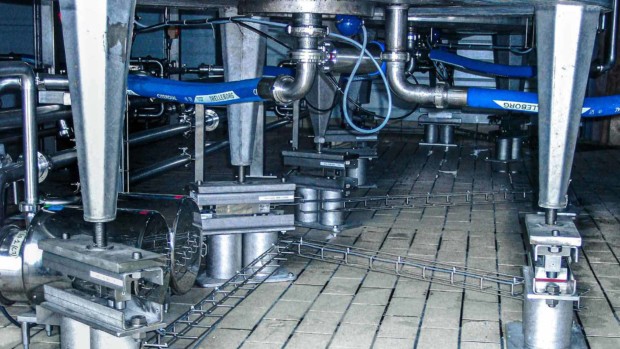
Independent signal per acquisition channel (multi-channel)
The physical environment determines the equipment's lifespan and measurement stability. A site visit very often reveals constraints that are absent from layout drawings.
Climatic and chemical environment: Extreme temperatures, rapid thermal fluctuations, high-pressure washdowns, presence of corrosive products, or ATEX hazardous areas.
Mechanical and structural constraints: Vibrations from agitators or neighbouring machinery, accidental impacts (forklift traffic), thermal expansion of metal structures, and flexibility of connected piping.
Operating mode: Are loads applied gradually or abruptly? Is it a continuous process (24/7) with no possibility of stopping for maintenance? How accessible are components for cleaning?
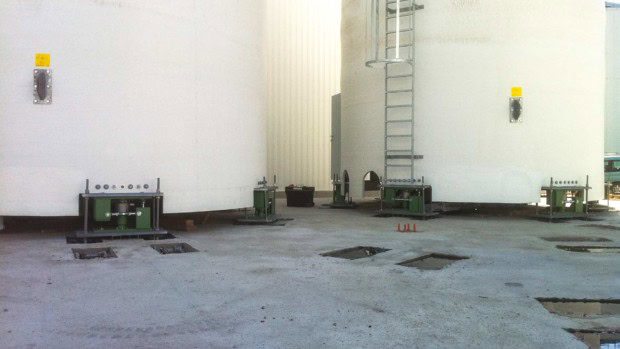
On outdoor tanks and silos, the thermal expansion of the framework under sunlight disrupts force transmission. The choice of mounting assemblies (self-centring mounting kits, anti-tip devices) is just as critical as the choice of the sensor itself.
To delve deeper into the selection criteria for measuring elements (capacity, spring element / body, accuracy class), please refer to our comparative guide to industrial weighing sensors.
Demanding “the best possible accuracy” is a common trap that needlessly inflates project costs without delivering operational value. Metrological performance must be strictly aligned with your process tolerances.
Measuring range: The span between the minimum value and maximum capacity.
Resolution (Display scale interval / Scale division): The smallest increment visible between two indicated values. A hyper-detailed display does not guarantee an accurate measurement and can obscure mechanical background noise.
Accuracy: The closeness of agreement between the measured value and the true reference mass.
Repeatability: The ability of the system to deliver the same result for the same applied load under identical conditions. In process weighing, repeatability is often far more essential than absolute accuracy.
Decision rule: Every metrological requirement must correspond to a product tolerance or an identified risk. If a recipe tolerance is , specifying electronics accurate to introduces instability without any operational gain.
Step 5: Design the functional architecture
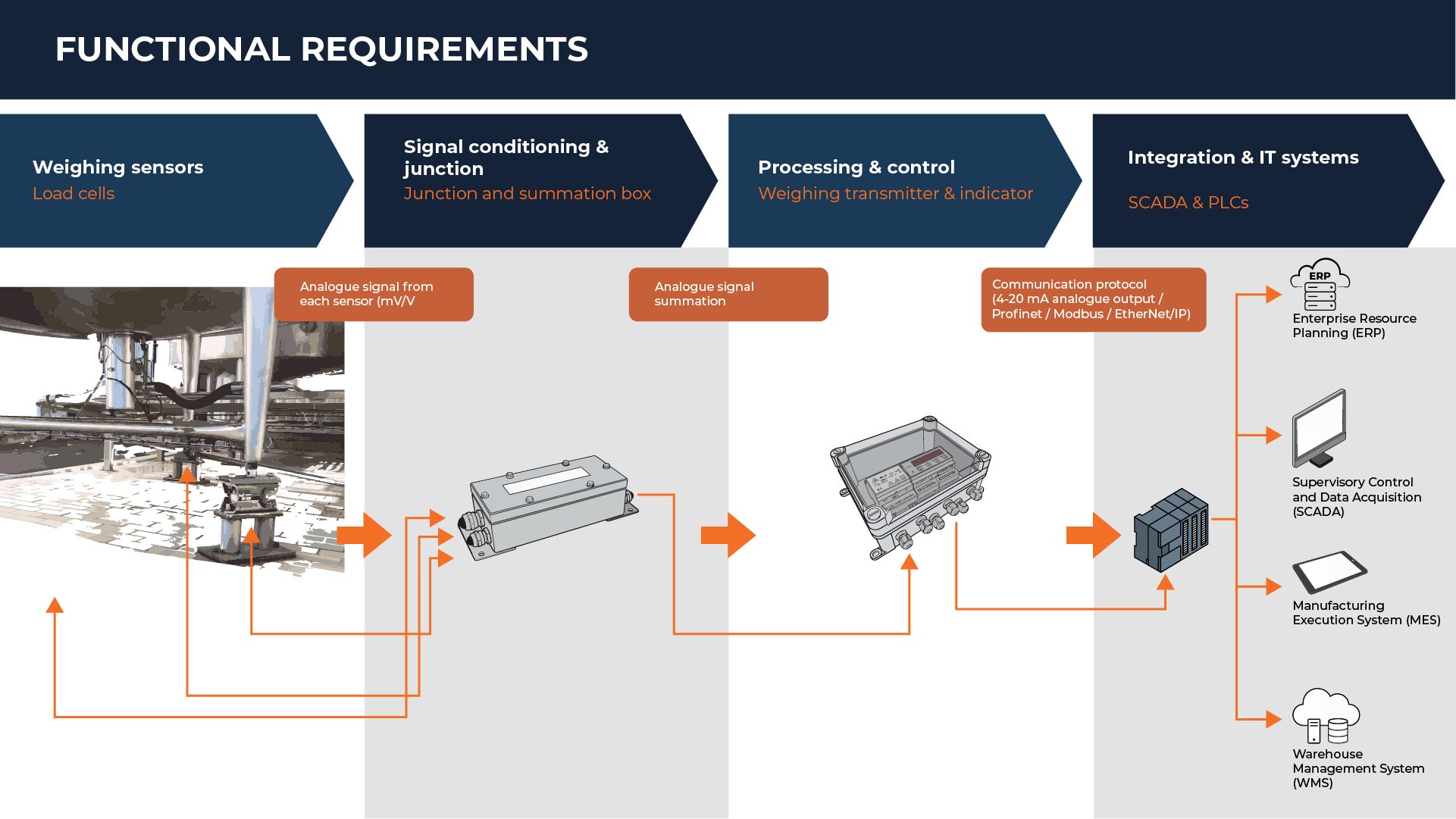
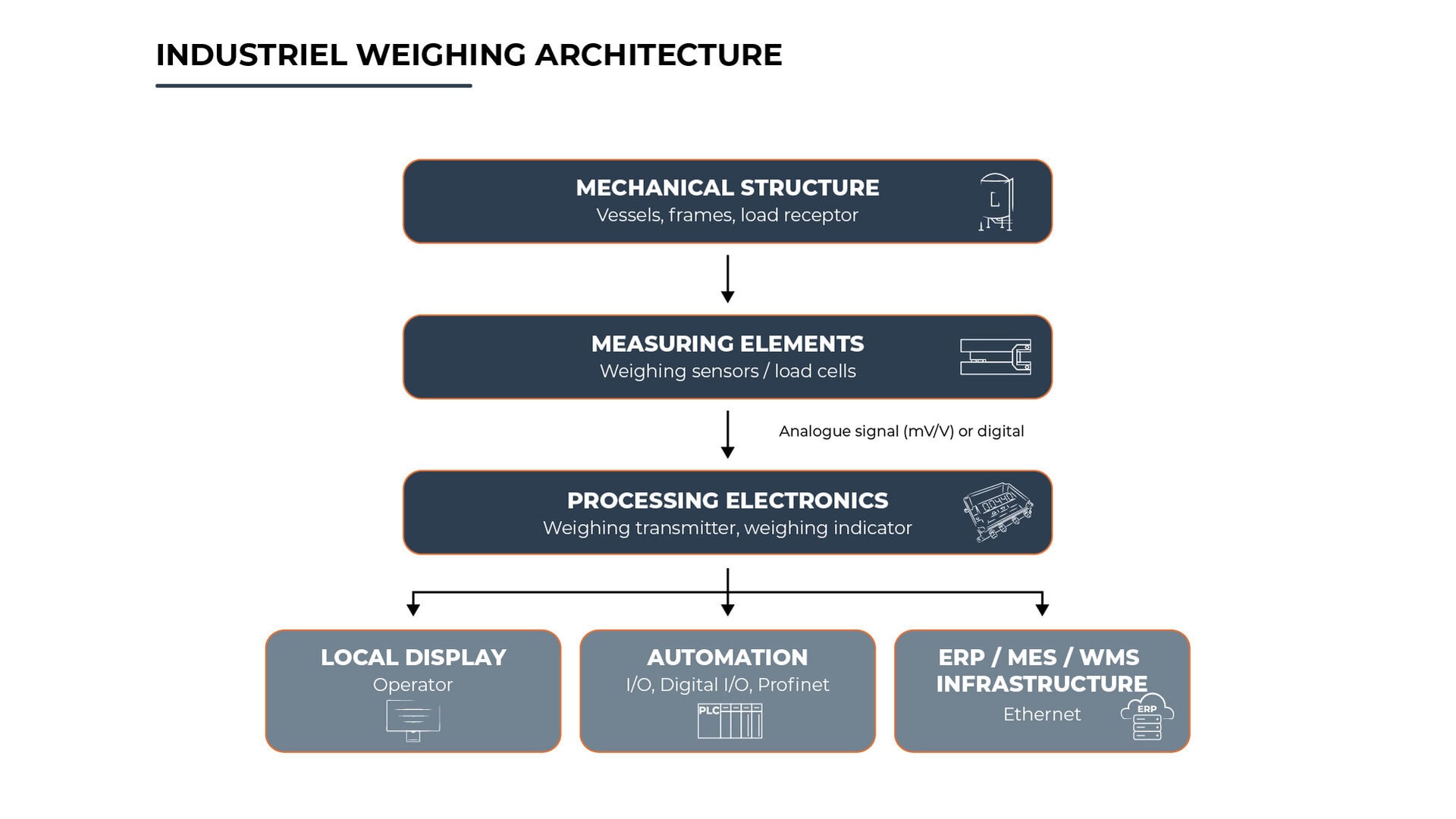
The functional architecture brings together signal processing, automation, and value display/output prior to selecting any commercial part numbers.
Depending on the complexity of your requirements, the architecture adopts one of the following configurations:
Standalone: Local reading on an indicator for simple visual checks or ticket printing.
Process-integrated: The weighing transmitter communicates in real time with the PLC (4-20 mA, Profinet, Modbus IP, EtherNet/IP) to control valves or conveyors.
IT-connected: The electronics transmit timestamped weighings along with identifier data to the WMS / ERP for inventory management and traceability.
Multi-point / Multi-channel: Independent processing of multiple load cells under a single structure to analyse balance and centre of gravity, or to monitor multiple tanks in parallel.
Step 6: Integrate weighing into the process and IT system
The weighing chain does not end with transmitting a numerical value. Successful integration clearly defines data governance and procedures for fallback/degraded operation.
Synchronization & timestamping: At what exact moment is the measurement captured? Which system generates the weighing ID (batch number, registration plate, item code)?
Exception handling: How does the PLC react if communication with the weighing transmitter is lost? Is there a manual override procedure to avoid blocking the line?
Scope of supply clarification: Explicitly define who provides, installs, connects, configures, and validates each boundary between the weighing manufacturer, electrician, automation supplier, and IT integrator.
Step 7: Plan for operation, maintenance, and on-site verification
A weighing system wears out and drifts over time. Its initial design must ensure that maintenance and calibration operations remain practical.
Mechanical accessibility: Designated space for positioning lifting jacks when replacing a damaged load cell.
Field metrological verification strategy:
Small to Medium Capacities: Use of certified standard weights, depending on feasibility.
Large Capacities (Tanks, Silos, Weighbridges): As bringing tens of tonnes of standard weights is often impractical or cost-prohibitive, verification is performed by substitution or by comparison using a bulk product truck previously weighed on a reference weighbridge.
Hard-to-access or ATEX-constrained areas: Use of a reference mass flow meter.
Diagnostics & critical spare parts: Selection of electronics with individual load cell diagnostic features (detection of wire breakage, zero drift, load imbalance).
TOOLBOX: SPECIFICATION CHECKLIST Leave no technical blind spots during your tender process. Download our free needs characterization worksheet (printable A4 format). It consolidates all engineering checkpoints (environment, connectivity, metrology, maintenance).
Verification procedure (standard weights or bulk), mechanical access
Common pitfalls when drafting specifications
Specifying hardware references too early: Locking the requirements document to a specific load cell model prevents the manufacturer from offering a more modern architecture or one better suited to your environment.
Confusing resolution with accuracy: Displaying weight to the nearest gram on a 10-tonne tank exposed to wind creates the illusion of accuracy, but merely reflects measurement noise.
Ignoring rigid connections: Connecting a weighed vessel with rigid piping without decoupling bellows voids the benefits of even the best sensor on the market.
Forgetting acceptance criteria: Failing to define the on-site testing protocol in advance (test loads, number of repetitions, acceptance conditions) inevitably leads to disputes during commissioning.
NEED SUPPORT WITH YOUR SPECIFICATIONS? A tailored weighing architecture avoids equipment overspending and ensures the long-term reliability of your installation. Our experts analyse your mechanical, environmental, and network constraints to validate the technical feasibility of your project.
Q&A: Everything you need to know about choosing an industrial weighing system
What is the difference between resolution and accuracy in a weighing system?
Resolution (or display scale interval) is the smallest increment that the indicator can display (for example, 0.1 kg). Accuracy reflects how close the displayed value is to the true reference mass. A system can display a very high resolution without actually being accurate if the measurement chain suffers from mechanical noise, thermal drift, or improper calibration.
How do I know if my installation must be approved for trade (Legal Metrology)?
Whenever a weighing value forms the basis of a commercial transaction (invoicing per kilogramme, bulk material sales, consignment weighing), a tax calculation, or a regulatory check, the installation is legally subject to Legal Metrology (OIML recommendations). The equipment must bear the green M mark, possess a metrology logbook, and undergo mandatory periodic verifications. For simple process tracking or internal dosing, non-approved industrial weighing is sufficient.
Which ingress protection (IP) rating should I choose for weighing sensors in an industrial environment?
In dry or moderately dusty industrial environments, an IP65 rating is suitable. For damp areas subject to regular washdowns, opt for IP67 (temporary immersion). In the food & beverage or chemical sectors, where daily high-pressure, high-temperature jet washing is required, an IP68 or IP69K rating is essential to prevent water ingress into the sensor body. Note that IP69K certification does not automatically guarantee protection against immersion (IP67/IP68).
Why do mechanical connections and piping disrupt vessel weighing?
When a vessel rests on load cells, any rigid piping or walkway attached to the structure exerts parasitic forces (shunting or lever effects) that absorb part of the weight. To ensure accurate measurement, flexible hoses/connectors must be used on piping, along with articulated mounting modules that absorb the thermal expansion of the metal without restricting vertical force.
How do I choose between a weighing transmitter and a local indicator?
A weighing indicator features a screen for direct local reading by operators and enables manual actions (tare, ticket printing). A weighing transmitter is a compact electronic device—typically DIN-rail mounted inside an electrical cabinet or panel-mounted on the cabinet door—whose primary role is to digitise the sensor signal and transmit it at high speed to a PLC (Profinet, Modbus IP, EtherNet/IP) or IT system.
Is it possible to calibrate a large-capacity vessel (over 20 tonnes) without standard test weights?
Yes. Transporting 50 tonnes of certified standard test weights to an industrial site is often technically impossible or cost-prohibitive. The volumetric calibration method is widely used in the food & beverage sector. It involves injecting water into the vessel measured by a reference flow meter. The operator adjusts this measurement based on liquid temperature and density, yielding an extremely precise calibration curve. This process is particularly recommended for hard-to-access installations.
How do vibrations affect measurements, and how can they be neutralized?
Vibrations generated by an agitator, crusher, or neighbouring machinery create background noise on the sensors' analogue signal, causing display instability. This issue is resolved through a two-fold approach: mechanical isolation of the structure (anti-vibration mounts) and the activation of dynamic digital filters built into the weighing electronics to smooth the signal without slowing down process throughput.
What is the average lifespan of an industrial weighing sensor?
In a controlled environment and without overloads, a stainless steel sensor is engineered to perform several million measurement cycles, often achieving a lifespan exceeding 10 to 15 years (such as Captels sensors). However, impacts from forklifts, electrical surges (lightning), or water ingress can reduce this lifespan. Analysing specific aging indicators identified during periodic inspections allows teams to anticipate system degradation before a failure occurs.
How do we integrate weighing data directly into our ERP / MES?
Integration takes place at the electronics or weighing software level via industrial Ethernet network protocols (TCP/IP). Data transmission (gross and net weight, timestamp, batch ID) to the ERP (SAP, Microsoft Dynamics, etc.) or MES is performed in real time using structured files (JSON, CSV), direct SQL queries, or dedicated API web services.
Why is it necessary to have a prior feasibility study conducted by a manufacturer?
Every site presents unique constraints that catalogue technical datasheets cannot anticipate (structural flexibility, residual vibrations, vehicle traffic flow, complex network architecture). A feasibility study carried out by an expert validates the mechanical behaviour of the load receptor, correctly sizes the sensors along with their safety factor, and locks down communication interfaces before committing capital expenditure.
Conclusion: Design the system around the real operational need
Engineering an industrial weighing system follows a top-down approach, moving from the operational requirement to product selection. Hardware (sensors, indicators, mounting modules) is merely the technical execution of a clearly defined operational function.
Structuring your requirements using this 7-step method ensures that your installation delivers accurate measurements, seamless integration with your automation systems, and controlled operating costs throughout its entire lifecycle.
Planning an industrial weighing project? Validate your architecture with our experts
Whether you are scoping a new project, modernising an existing process, or drafting your specification document, our experts are here to guide you. We analyze your mechanical, environmental, and network constraints to direct you toward the most performant and reliable weighing architecture for the long term.
Technical response within 48 hours from our France-based teams. No purchase obligation.
Olivier GARCIA
Technico-Commercial
- Expert en pesage industriel depuis plus de 35 ans -
Spécialiste de la mesure de masse, j'accompagne les industriels dans le choix et la mise en oeuvre de leurs équipements. Mon expertise couvre aussi bien le pesage de process (cuves, silos, trémies) que le pesage de véhicules (routiers, agricoles et ferroviaires). Au sein de Captels, je conçois des solutions sur mesure adaptées aux contraintes techniques et réglementaires.
In the Industry 4.0 ecosystem, data is the engine of performance. Industrial weight measurement plays a fundamental role in numerous production and control processes. Whether dosing raw materials, monitoring filling levels, supervising automated lines, or ensuring equipment safety, the reliability of the weighing system is strategic.
At the heart of these systems lie industrial load cells, also known as weight sensors or force measurement cells. Often invisible as they are integrated into structures—under silos, tanks, or conveyors—they convert mechanical force into data usable by automation systems. Their precision, stability, and robustness directly determine the reliability of the overall system. They are the critical element of any measurement chain; an unsuitable selection can lead to metrological drift, production downtime, premature wear, or non-compliance.
In the process industry, inventory accuracy is paramount. However, weighing a 50-tonne vessel or a 200 m³ storage silo under industrial conditions is not as simple as installing weight sensors and reading a display. It requires designing a complete measurement chain capable of withstanding agitator vibrations, extreme thermal variations, corrosive environments (chemical washdowns, ATEX zones) and regulatory constraints. Poor mechanical integration or poorly isolated piping can completely compromise process accuracy. So, how do you transform a massive structure into a high-precision measurement tool? This guide provides the key insights for robust weighing instrumentation, from selecting the right sensor technology to on-site commissioning.