In the food processing industry, weighing raw material bulk storage silos represents a critical production challenge. It governs formulation accuracy, inventory management, and regulatory traceability.
This project presented an exceptional level of technical complexity. It combined three simultaneous constraints rarely brought together on a single site: a nominal payload of 330 tonnes per silo, a structural resistance requirement of 530 tonnes in the event of water filling for fire suppression, and a powdered starch storage environment requiring specific precautions regarding dust explosion risks.
Food processing industry – Bulk raw material storage
Powdered starch
330 tonnes per silo
530 tonnes (firefighting water deluge filling)
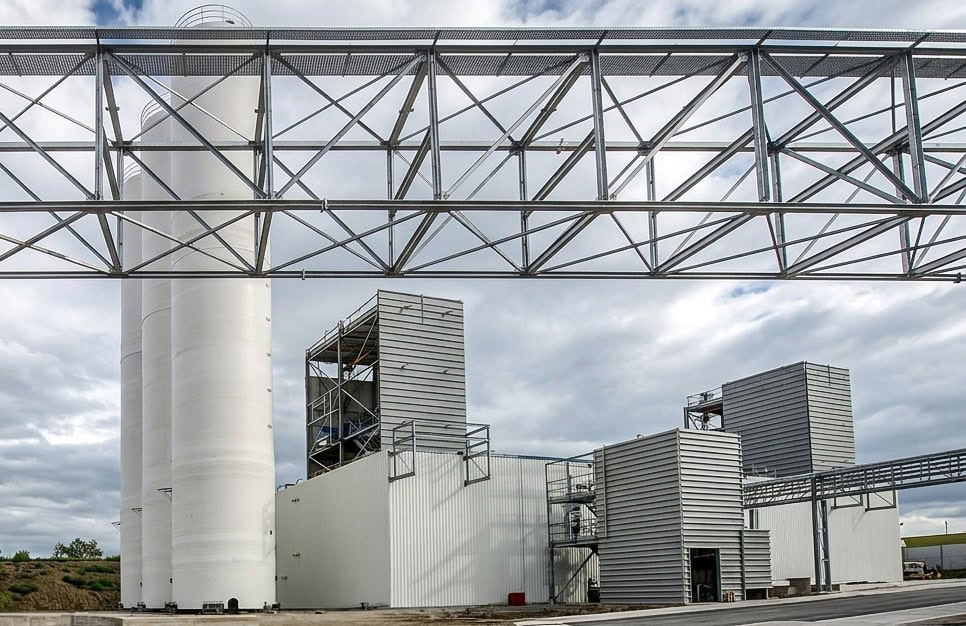
Bank of 4 large-capacity silos
ATEX Zone 21 (combustible dust inside the silo and in the immediate vicinity of discharge points)
Ambient temperature (-10 ^∘ C to +40 ^∘ C), high humidity (nearby high-pressure cleaning), and vibrations from pneumatic extractors at the silo base
Required accuracy of ±0.3% of maximum capacity (±1" tonne" for 330" tonnes" ) for rigorous inventory management
Sizing load cells for a nominal load of 330 tonnes is demanding in itself. However, engineering them to mechanically withstand 530 tonnes—a 60% increase over the nominal load—without permanent deformation or structural failure represents an extraordinary technical specification.
This requires rigorous material selection, bespoke mechanical design, and validation via finite element analysis prior to manufacturing. It is precisely this type of challenge that only a manufacturer controlling the entire value chain can successfully overcome.
Captels designed, manufactured, and installed an under-silo weighing system based on load cells specifically sized to address all three simultaneous constraints: measurement accuracy under nominal conditions, mechanical resistance to accidental overload, and compatibility with the ATEX environment.
| Specifications | Values |
|---|---|
| Type of load cells | High-capacity self-centring compression load cells |
| Nominal capacity per cell | 6 load cells of 100t (Model C1) per silo (providing safety margin and enhanced stability) |
| Number of cells per silo | 6 weighing points per silo for optimal load distribution across the silo skirt |
| Total capacity per silo (nominal) | 330 tonnes |
| Mechanical resistance (overload) | 530 tonnes (documented calculation validation) |
| Applied safety factor | Overload ratio of 1.6 (160%) relative to nominal capacity without structural failure |
| ATEX certification | Marking II 2 D Ex tb IIIC T85°C Db (suited for Zone 21) |
| Ingress protection rating | IP68 (total protection against dust and prolonged immersion) |
| Material / Surface treatment | High-strength stainless steel with anticorrosion treatment |
| Achieved measurement accuracy | ±0.25% under real operating conditions (approx. ±800" kg" on 330 tonnes) |
| Associated weighing indicator | TNP weighing transmitter with intrinsic safety barriers (Zener barriers) |
| Commissioning timescale | 3 weeks (including mechanical assembly, ATEX cabling, and calibration via weights and hydraulic simulation) |
In industrial metrology, a sensor’s theoretical accuracy on a test bench is one thing; its real-world accuracy once installed beneath an outdoor 330-tonne silo is quite another. Parasitic forces (rigid connections, thermal expansion) and weather conditions (wind load) naturally disrupt measurements.
To maintain optimal inventory accuracy, Captels deployed a rigorous integration protocol:
Mechanical isolation : Audit and specification of flexible sleeves on all feed piping to eliminate vertical load shunting.
Digital filtering : Configuration of advanced filters on the weighing transmitter to smooth the impact of vibrations from pneumatic extractors and wind gusts.
Controlled comparative calibration : Implementation of a strict mass transfer protocol via a Class III weighbridge to minimize initial calibration uncertainty.
Accurately weighed nominal load
Validated mechanical resistance
Measured result following thermal stabilisation
Documented continuous operation
| Indicator | Measured result |
|---|---|
| Measurement accuracy | ±0.25% of full scale achieved under real production conditions (approx. ±800" kg" for a nominal capacity of 330 t—an optimal result for continuous inventory tracking). |
| Overload resistance | 530 t—zero deformation or failure observed following the critical load simulation test. |
| ATEX compliance | Installation compliance certification validated following on-site inspection (verification of equipotential bonding, sealed junction boxes, and Zener barriers). |
| System availability | 99.98% availability / Zero corrective after-sales callouts since commissioning. |
| Operating lifespan | 5 years of documented 24/7 operation with no major metrological drift. |
| Traceability / calibration reports | Annual inspection via comparative method; complete traceability history accessible via the TNP transmitter. |
This project demonstrates several dimensions of Captels' expertise that can only be offered by an integrated manufacturer:
Citation client :
The challenge was to achieve reliable inventory tracking on 330-tonne silos subject to severe environmental constraints and fire safety requirements. With support from Captels’ engineering team on mechanical isolation and signal filtering, we achieve an inventory accuracy of ±0.25%. Their ability to certify fire overload resistance allowed us to validate installation compliance without sacrificing weighing performance.
Technical Director, international food processing group
Captels client since 2012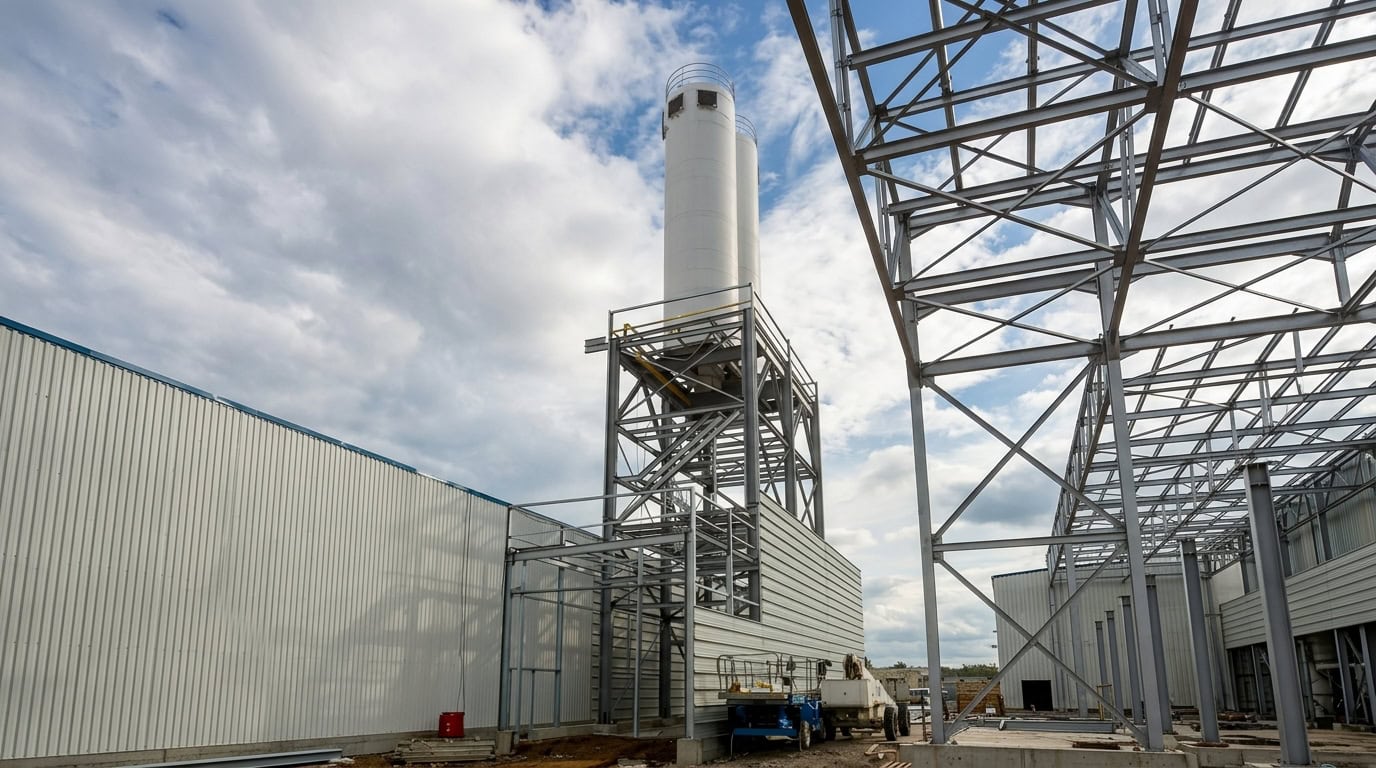
Website created by Citron Noir
